We want to make philosophical inquiry accessible, communal, and alive for everyone.
Help us create it in SF!
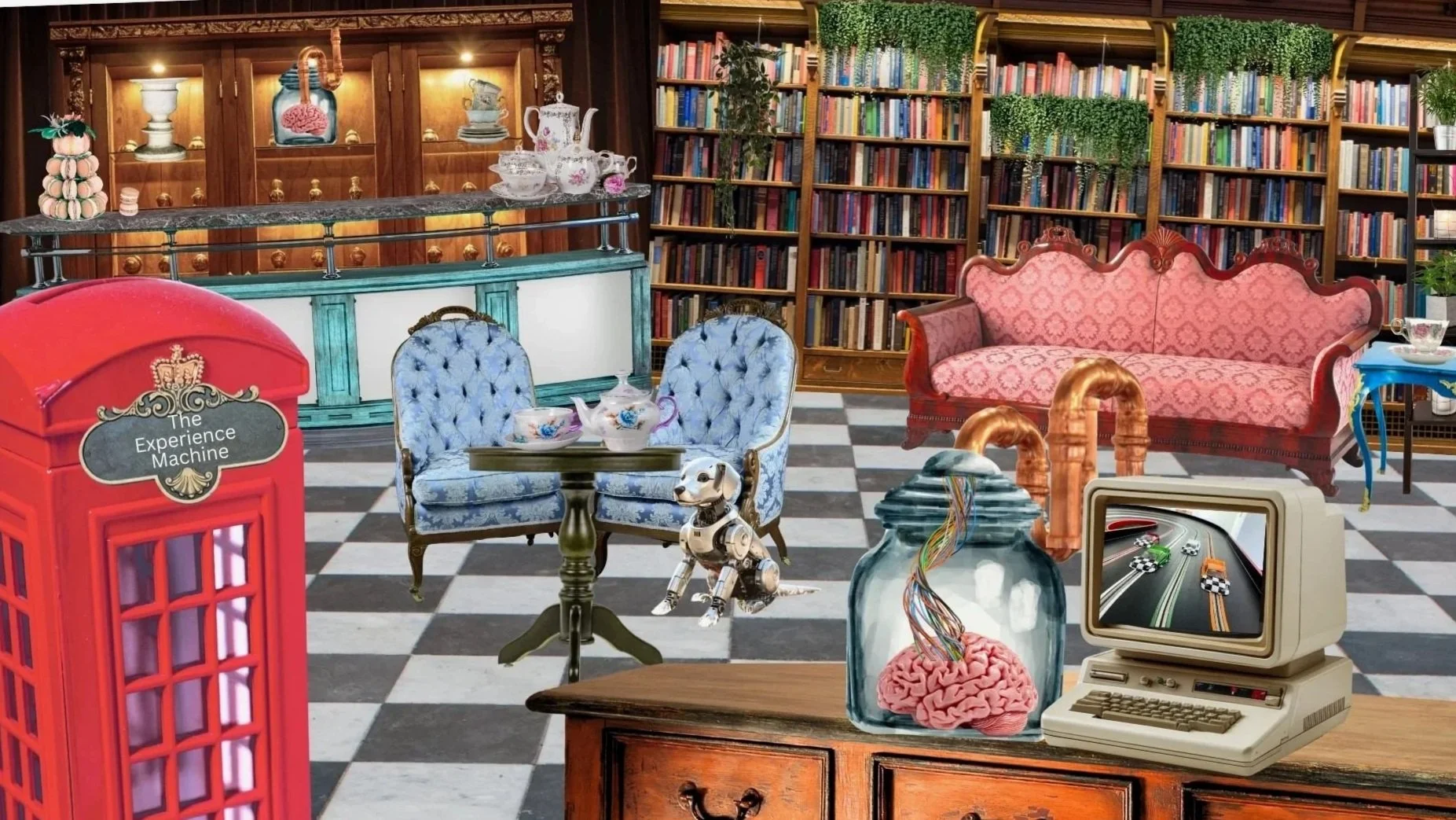
We envision a San Francisco where philosophical inquiry is not confined to university classrooms or dusty texts — but part of everyday neighborhood life. The Parlor of Ideas would be a warm and welcoming space where wonder and reflection are practiced over a cup to tea. Our society today is navigating the profound challenges posed by artificial intelligence, information overload, and social fragmentation. We believe that a safe space —where assumptions can be challenged, reasoning can be slow, and participants can play together with uncertainty — is one of the most urgent needs of our time.
If you would like such a space to exist in San Francisco, please fill out our brief survey.
More Details
Key Highlights
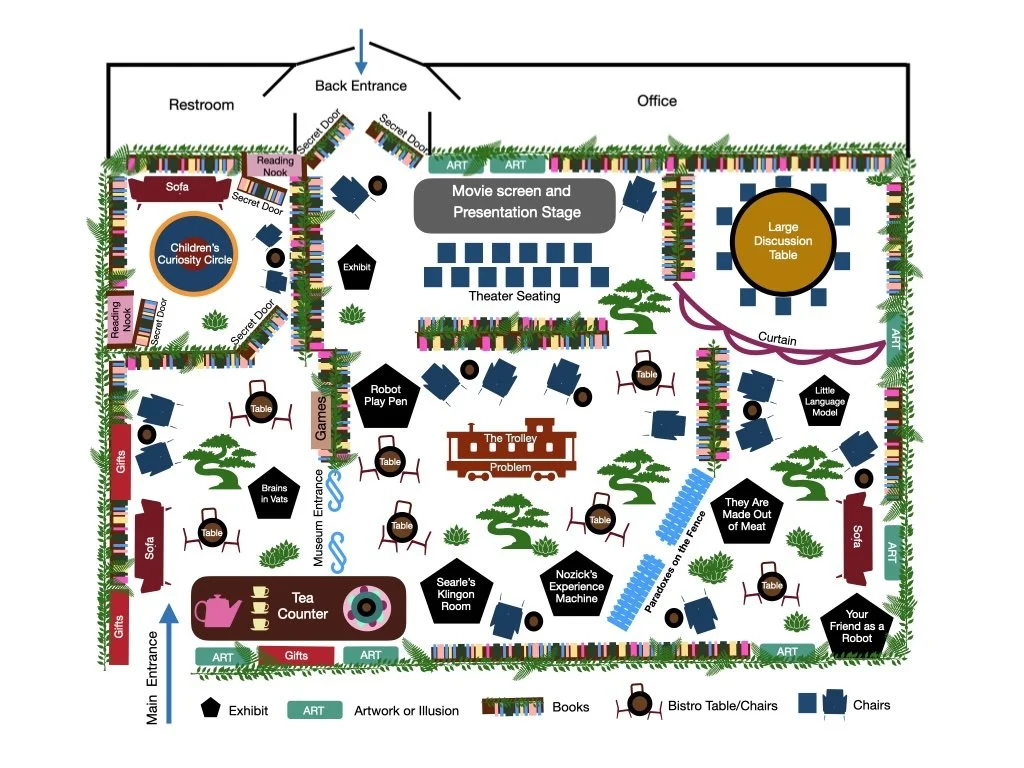
Interactive philosophy exhibits on mind, AI, consciousness, knowledge, cognitive bias, art, and ethics
Curated library of philosophy, cognitive science, and related themes
Salon-style discussion spaces for workshops and community gatherings
Dedicated programming for children, teens, and adults
A stage for scholar talks and film screenings
Tea and snack counter
Gift shop with puzzles, books, illusion art, and philosophical gifts
Located in a walkable San Francisco neighborhood
Nonprofit 501(c)(3) organization with a community-first mission
Core Values
Curiosity
Accessibility
Community
Playfulness
Nuance and Paradox
Interdisciplinarity
Inaugural Exhibits (help us build these!)
The Ship (and Brain) of Theseus: Visitors physically re-assemble a model ship, piece by piece, voting on when it becomes something new. Nearby is a model ‘Brain of Theseus’, where participants replace brain cells one at a time (either with other brain cells or silicon chips), voting on whether and when it becomes a different brain/person.
The Klingon Room: — A small ‘confession booth’ where visitors experience Searle's Chinese Room thought experiment, in which symbol manipulation occurs without understanding. Visitors take turns being inside or outside the room, exchanging strings of symbols with each other, using a large look-up table that connects input strings of Klingon language to more strings, and ultimately to an output string. What would it take for a machine to understand words in Klingon?
The Brain in a Vat: An artificial brain is floating in a vat, with wires connected to a computer that projects a simulated reality. Could this be your brain? Where is the person here, in the vat or in the (simulated) environment? What if a duplicate of the brain were created and connected to the same simulation, and what if the brain were connected to two different simulations? Inspired by Descartes’ ‘Evil Genius’ thought experiment, and Dennett’s short story, “Where Am I?”.
Robots: Various robot and AI devices are displayed for interaction. These include Siri, Alexa, Character.AI, a simple robot cat, and Sony’s sophisticated robotic dog, Aibo, Do these robots think about the world? Do they experience the color pink (as you do)? Do they understand the words like “dog” and “sit”? What would it take for a machine to have these various mental traits?
Robot Aliens: Based on Terry Bisson’s short story, “They are Made our of Meat", two silicon-based aliens are having a dialogue about a tiny planet they discovered. One is claiming that the meat-based creatures there are sentient, while the other is skeptical. “How can meat be sentient?”
Your Companion as a Robot: A pair of visitors enter a small room where a robotic body is projected onto a reflection of one person, appearing as an x-ray. Two questions are posted on the wall: If you discovered that your companion is a robot, would you still think they care about you? If you discovered that you are in fact a robot, would you still think you care about others?
The Trolley Problem: A San Francisco trolly model is on a track that could squish various pairs of 1 vs 5 items —toy people, toy seals, pieces of clay, — presenting moral dilemmas and real-time displays of how others choose.
The Veil of Ignorance: Based on Rawls’ thought experiment. From behind a ‘veil’, visitors choose laws and conventions for a virtual video-game society of animals before finding out their position in the society —ducks have the most power and money, dolphins are the most intelligent but can’t walk on land, giraffes need the most food. Visitors are then given an animal avatar and play the video game from that perspective. Which laws would be the most fair from behind the veil?
Perceptual Illusions: Throughout the space will be various perceptual illusions, along with questions about reality and our representations of reality.